ADHD & Omega-3
Can extra long-chain Omega-3 really support people with ADHD?
Neither ‘ADHD’ nor ‘Omega-3’ are single ‘things’
ADHD is an ‘umbrella’ diagnosis, covering a wide variety of difficulties with attention and/or behaviour, so individual differences are the rule. The challenges of ADHD are
very real, but the label itself is only descriptive – it does not explain those difficulties
Grouping different ‘presentations’ of ADHD, & overlapping challenges, into one single category prevents meaningful conclusions.
What ‘works’ for some individuals may not help others.
- The core defining features of ADHD inattention and/or hyperactivity impulsivity represent extremes of normal individual differences in cognition and behaviour.
- There is no clear ‘dividing line’ between those with and without ADHD – diagnosis rests on the severity of the difficulties, and their impact on the individual.
- ADHD rarely occurs on its own – rather, it overlaps strongly with many other developmental, mental, & physical conditions.
- The causes of ADHD are multi-factorial involving biological, psychological & social elements that all interact, and vary between individuals.
Why do we need Omega-3 fats?
- Omega-3 & omega-6 are both ‘Essential Fatty Acids’ because they are vital for human life & health, but we can’t make them for ourselves- so they must come from our diets.
- These fats play critical roles in brain development & function, and a steady supply is needed to support mood, behaviour and learning.
- Omega-3 play key roles in vision, heart health & blood flow, energy metabolism, immune responses, hormone balance, and more including gene expression and regulation, and almost all cell signalling.
- Omega-3 help to
control inflammation - and excessive or chronic inflammation is linked with a wide
range of physical and mental health conditions, including ADHD. Typical modern diets lack omega-3, but provide an excess of omega-6 fats. Correcting this imbalance can help prevent harmful outcomes
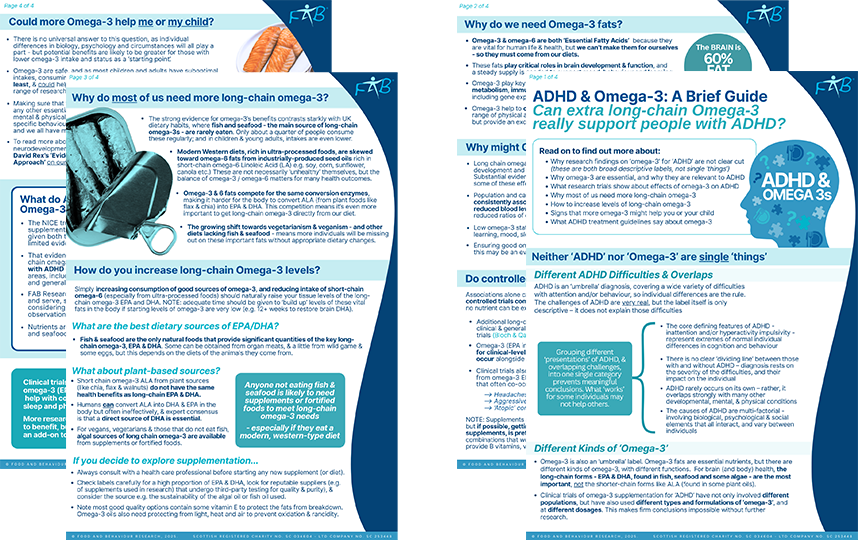
Sign up above to get the FULL downloadable PDF of this article on ADHD & Omega-3, which covers even more on:
- Different Kinds of ‘Omega-3’. Omega-3 fats are essential nutrients, but there are different kinds of omega-3, with different functions.
- Why might Omega-3 be relevant to ADHD?
- Do controlled treatment trials show omega-3 can help?
- Why do most of us need more long-chain Omega-3?
- How do you increase long-chain Omega-3 levels? What are the best dietary sources of EPA/DHA? What about plant-based sources?
- Could more Omega-3 help me or my child?
- What do ADHD treatment guidelines say on Omega-3? ⟶ and does it matter?
Unlock these
extra
sections by signing up above


Disclaimer
As always – we emphasise that FAB's resources are provided for educational and informational use only, based on the current available evidence at the time of creation. This does not represent a substitute for personalised health care advice - and we encourage individuals to always seek advice from their GP and/or other registered Health Care Professional.
FAB For the NHS
Are you?
- an NHS employee
- a UK university staff member or student
And are you interested in
- how the NHS could improve its support for both patients and staff by taking more account of the importance of nutrition and diet for mental (as well as physical) health and wellbeing?
If so, then please sign up for FREE Updates and News on FAB's work with the NHS here.


Food and Behaviour Research relies on donations to make articles and PDFs like this one freely available.
Make a quick and easy donation of ANY AMOUNT and help support our Charity to create future articles and resources.
Looking for even more exclusive content?
Join us as a FAB Associate to access our audio-visual library and resources, and attend our live events for free.
All donations are very gratefully received
Thanks so much for your support
Contact Us
Contact Us
Watch our recent FAB Live webinar and Q&A session on this topic
Share this article
Read more on the importance of Omega-3